—And a Powerful Reminder Why Sonoma Needs Its PCD Now
The sooner you know a threat is coming, the better you can defend against it. That’s why Penn State Extension’s brand‑new 2025 Spotted Lanternfly (SLF) Hatch Predictor is grabbing headlines in the East—and why it should grab our attention here on the North Coast.
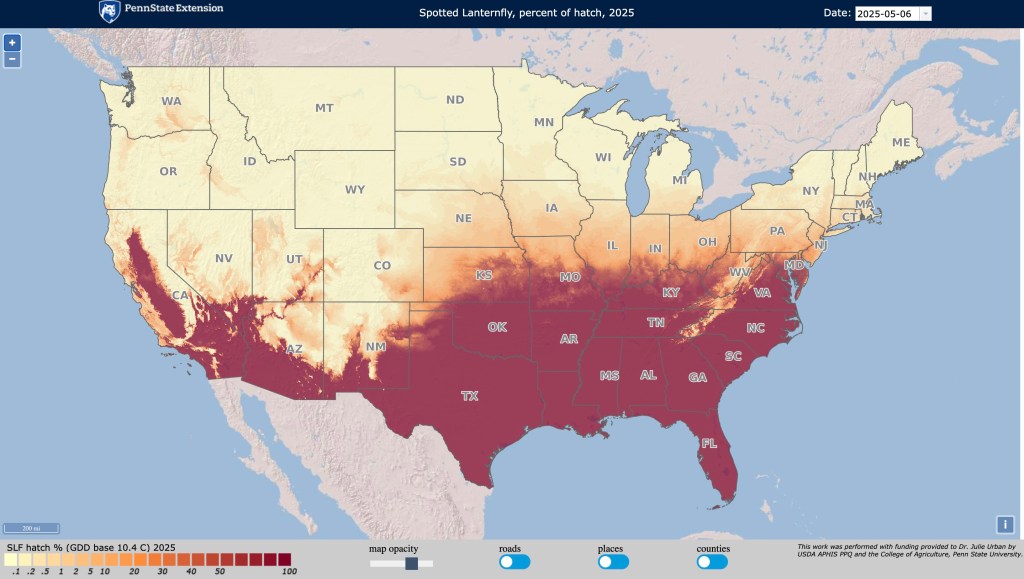
Developed by Dr. Dennis Calvin and Steve Crawford, the tool forecasts when SLF eggs will hatch if the pest already exists at a location. Pennsylvania field crews report the model is tracking this season’s first‑instar emergence with uncanny accuracy.
But remember: the map predicts timing, not presence. Green or red shading means, “If SLF were here, it would be hatching now.” – Brian Walsh, Spotted Lanternfly Researcher, Horticulture Educator Penn State Extension, Berks County, Penn State University, College of Agricultural Sciences
What the Predictor Offers (and What It Doesn’t)
| ✅ Adds Value | 🚫 Won’t Do |
|---|---|
| Pinpoints hatch windows down to a four‑kilometer grid, ideal for scheduling scouting, sprays, or outreach. | Confirm SLF in an area. Use trapping and egg‑mass surveys for that. |
| Time‑slider lets you roll the calendar forward or backward—great for training and “what‑if” drills. | Eliminate micro‑climate quirks—expect hatch to vary weeks within a single block or even the same tree. |
| Pairs perfectly with local degree‑day models and weather data for a full phenology picture. | Replace boots‑on‑the‑ground scouting. Nothing beats field eyes. |
How Sonoma County Can Put It to Work—Before SLF Arrives
- Bookmark & Share the Map
Keep the link on your phone or office desktop. Show it to crews, neighbors, and community groups—but always remind them it’s a phenology model, not a detection map. - Run Scenarios
Slide the date back to April or May to see how spring hatch progressed in the mid‑Atlantic. That timeline could be ours once SLF crosses state lines. - Layer Local Data
Feed the predictor’s dates into your own heat‑unit calculators. Align spray thresholds, vineyard tasks, and worker training days to match likely hatch spikes. - Use It as a Teaching Tool
In toolbox talks and tailgate sessions, walk workers through photos of first‑instar nymphs and egg‑mass scrapes. Show them when to expect activity so they know what to look for.
The Bigger Picture: Why a Pest & Disease Control District Must Come First
Penn State’s predictor is a brilliant piece of tech, but technology is only half the battle. The other half is infrastructure—a county‑wide system that can turn good intel into fast, coordinated action. That system is a Pest & Disease Control District (PCD).
Without a PCD
- Each grower scouts and treats—or doesn’t—in isolation.
- Infestations leapfrog property lines and ornamental landscapes.
- Momentum stalls while we scramble for funding, protocols, and public outreach.
With a PCD
- Shared monitoring grid: traps, degree‑day stations, and predictive models feed a central dashboard.
- Rapid‑response fund: dollars already earmarked for bulk beneficials, targeted sprays, and community education.
- Unified messaging: consistent alerts to schools, nurseries, landscapers, and homeowners so no “weak link” goes unaddressed.
The cost? About $5 per acre—a rounding error compared to the 90 percent yield losses some Pennsylvania vineyards endured before coordinated action kicked in.
Call to Action: Future‑Proof Our Vineyards
Penn State has given us the “early‑warning radar.” Let’s make sure we also have the fire station, fire trucks, and trained crew ready to roll when the alarm sounds.
- Watch the Predictor: Familiarize yourself with the tool and share it responsibly.
- Sign the Petition: When the next round of PCD petitions circulates, add your name—and encourage neighbors to do the same.
- Stay Engaged: Follow the Sonoma County PCD Coalition for training dates, trap‑kit giveaways, and legislative updates.
Bottom Line
Every day we delay formalizing our PCD is a day we risk turning a preventable problem into an economic disaster. Let’s turn this high‑tech hatch map into high‑impact action—before Spotted Lanternfly ever touches a vine in Sonoma County.
Questions or ideas? Drop them in the comments, or reach out to the Sonoma County PCD Coalition. Together, we’ll keep Sonoma’s vineyards thriving for the next generation.
 Sonoma County Pest Control District Coalition