July 18, 2025 — Researchers at the USDA-ARS Appalachian Fruit Research Station—working in partnership with Virginia Tech, Penn State, Rutgers University, and others—are leading a multi-state initiative, Areawide Management of the Invasive Spotted Lanternfly and Tree of Heaven. This project aims to suppress populations of both invasive species to improve ecosystem health, reduce insecticide use in vineyards, protect pollinators, and minimize crop losses.
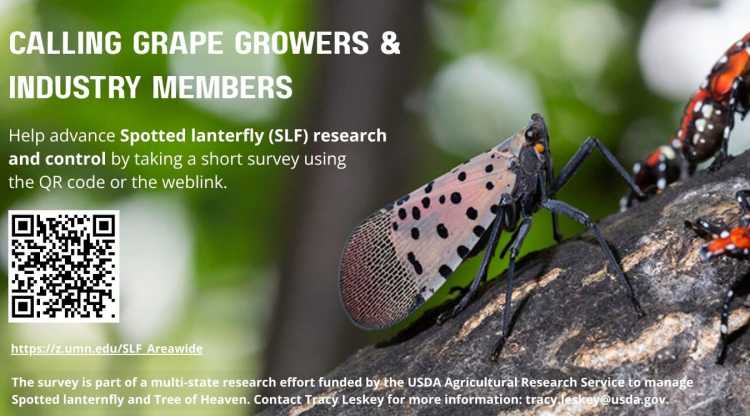
Your input is vital. Help guide this important research by taking a brief survey about how Spotted Lanternfly is—or could—impact your business as it spreads. Your responses will help shape future management strategies. Take the survey now.
The following is an excerpt from the survey:
We invite you to participate in a survey that will help researchers develop and evaluate solutions to control the spread of the non-native invasive species: Spotted Lanternfly (nymph stage below left, adult below center) and Tree of Heaven (below right). This survey is part of a collaborative project conducted by USDA-ARS, Virginia Polytechnic Institute and State University, Penn State University, Rutgers University, University of Georgia, and University of Minnesota to study “Areawide Management of the Invasive Spotted Lanternfly and Tree of Heaven.”
Tree of Heaven (TOH), Ailanthus altissima, is an invasive species introduced into the US in the late 1700s. Unfortunately, TOH also supports survivorship and development of a recently introduced invasive planthopper, Spotted lanternfly (SLF), Lycorma delicatula. This invasive insect prefers TOH as a feeding host season-long, and is often present in extremely high densities on trunks, leading to a large pest reservoir in unmanaged habitats. Unfortunately, SLF also feeds on other hosts plants including wine grapes, Vitis vinifera and other Vitis species, resulting in increased insecticide inputs, reduced yields and grape ripeness, and vine decline in some instances. Because of the close insect-plant relationship between SLF and TOH, we have an opportunity to manage both invasive species simultaneously across the landscape using compatible biological control agents. In doing so, we hope to reduce the spread of SLF and its impacts in vineyards.
 Sonoma County Pest Control District Coalition